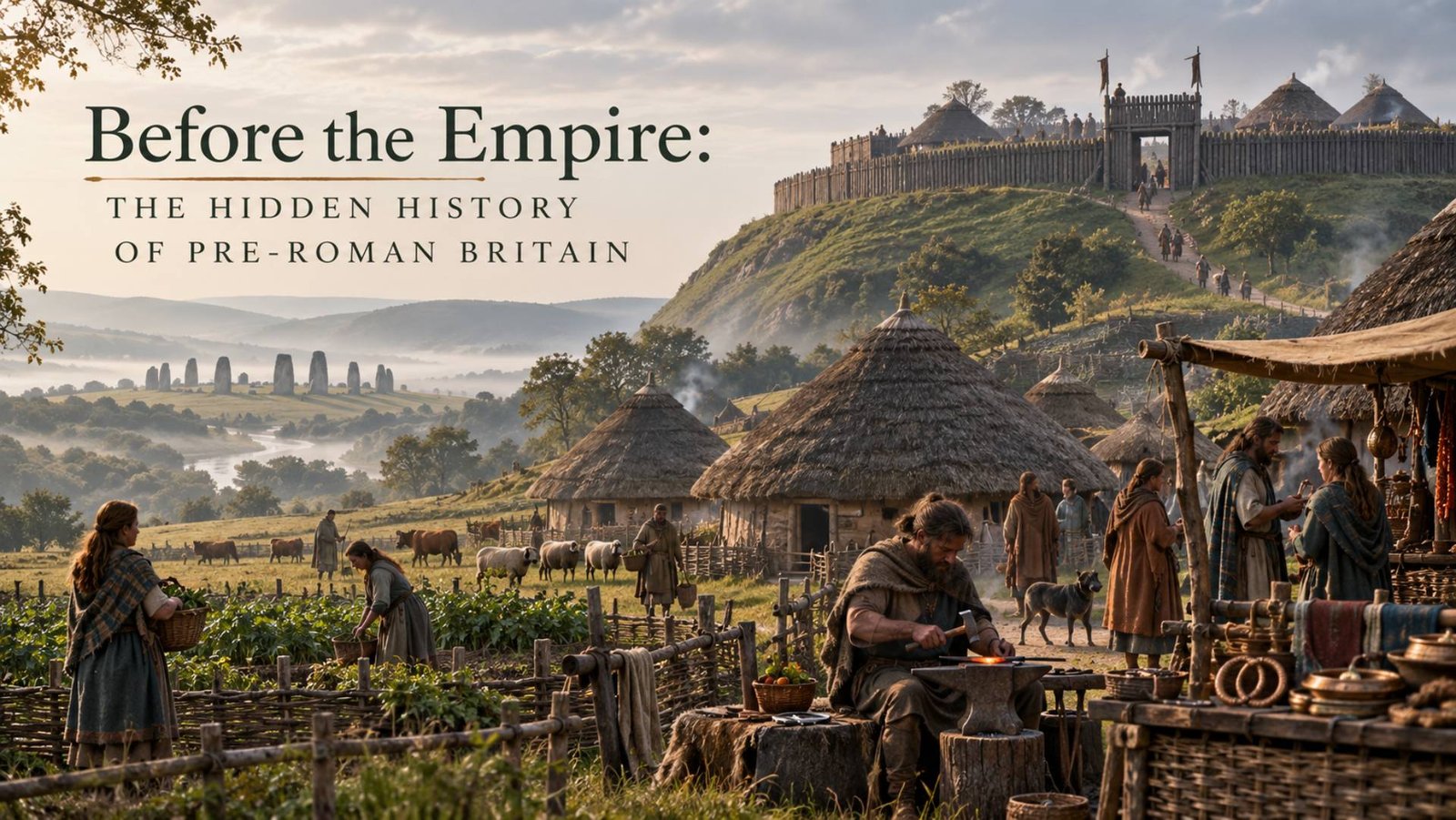
The island we now call the United Kingdom holds a layered past, where the footprints of prehistoric hunters and the structured order of Roman legions lie buried beneath the modern landscape. To study the history of Britain before the arrival of the Anglo-Saxons is to uncover a saga of migration, monumental engineering, and profound cultural transformation. We explore a time when the island was known as Britannia, a name that evokes both mystery and the stark reality of early European life. This journey will take us from the earliest settlements through the reign of the Celts and the lasting impact of Roman occupation, tracing the roots of today’s nation.
Key Takeaways
➜ Britain was inhabited for thousands of years before the Roman conquest.
➜ Hunter-gatherer communities adapted to major changes in climate and landscape.
➜ Neolithic farming led to permanent settlements, ceremonial sites and monuments such as Stonehenge.
➜ Bronze Age communities developed metalworking and wider trade networks.
➜ Iron Age Britain contained many distinct tribal societies rather than one unified Celtic nation.
➜ Hillforts served as centres of settlement, trade, defence and social authority.
➜ Britain traded with continental Europe long before Roman forces arrived.
➜ The Roman invasion of AD 43 changed Britain, but many older customs and identities survived.
| Period | Approximate Date | Main Features | Important Evidence |
|---|---|---|---|
| Palaeolithic | Before 10,000 BC | Nomadic hunter-gatherers followed animals across cold tundra landscapes. | Early stone tools and human remains |
| Mesolithic | c. 10,000–4000 BC | People adapted to warmer forests and relied on fishing, hunting and coastal resources. | Microliths and Doggerland |
| Neolithic | c. 4000–2500 BC | Farming, permanent settlements and large ceremonial monuments developed. | Stonehenge, Avebury and Skara Brae |
| Bronze Age | c. 2500–800 BC | Bronze tools, weapons, social hierarchies and long-distance trade networks became more common. | Round barrows and the Amesbury Archer |
| Iron Age | c. 800 BC–AD 43 | Tribal societies, ironworking, hillforts, warfare and regional leadership shaped Britain. | Maiden Castle, the Iceni and the Brigantes |
| Roman Conquest | AD 43 onwards | Roman rule introduced new administration, roads, towns, military bases and cultural influences. | Roman roads, Bath, York and Hadrian’s Wall |
Pre-Roman Britain: The Dawn of Civilisation
Long before political borders were drawn, Britain was a land defined by its geology and its inhabitants’ ability to adapt. This era, spanning thousands of years, saw revolutionary changes in how people lived, sourced food, and organised their communities. Archaeological sites across the country serve as silent witnesses to these dramatic shifts, painting a picture of innovation and evolving social complexity. Understanding this pre-Roman era is crucial to grasping the foundations upon which all subsequent history was built.
Palaeolithic & Mesolithic Eras
The earliest documented human presence in Britain stretches back hundreds of thousands of years, long before the island became separated from mainland Europe by the rising sea. During the Palaeolithic period, or Old Stone Age, nomadic hunter-gatherers followed herds across the tundra landscape. A prime example is the 10,000-year-old skeleton known as Cheddar Man, discovered in Gough’s Cave in Somerset, which offers direct insight into the physical traits and diet of these early inhabitants. Following the end of the Ice Age, the Mesolithic period saw people adapt to a warmer, forested environment, leading to the development of new, smaller flint tools, known as microliths, and a greater reliance on fishing and coastal resources. The vast, submerged land bridge known as Doggerland was a crucial hunting ground before it was finally flooded around 6500 BC, forever changing the geography of Britain.
Neolithic Revolution
Around 4000 BC, a profound shift occurred with the arrival of the Neolithic Revolution: the transition from a hunter-gatherer lifestyle to settled agriculture. This fundamentally altered the landscape, leading to the clearing of forests for crops and the creation of permanent villages. Crucially, this era is defined by the incredible surge in monumental construction. Stonehenge, the world’s most famous prehistoric monument on Salisbury Plain, was erected and refined over more than 1,500 years, requiring astonishing organisational skill and astronomical knowledge to position the enormous sarsen and bluestones. Similarly, the great stone circle at Avebury in Wiltshire, large enough to encompass an entire village, showcases the spiritual and communal power wielded by these early societies. Furthermore, the meticulously preserved village of Skara Brae on the Orkney Islands provides a rare and detailed view of sophisticated Neolithic domestic life, complete with stone furniture and drainage systems.
Bronze Age
The advent of metallurgy marked the Bronze Age, beginning in Britain around 2500 BC, where the technology to mix copper and tin to forge bronze revolutionised tool and weapon production. This new technology facilitated extensive trade networks, connecting British communities with continental Europe as they exported valuable metals. Society grew increasingly stratified; the wealth gained from metalworking is evident in the rich deposits of gold objects and elaborate weapons found in burial sites, particularly under large round barrows which signified status and power. The Amesbury Archer, whose lavish burial included gold ornaments and copper tools, is a vivid example of a high-status individual, perhaps an early metalworker or chieftain, demonstrating complex social hierarchy and mobility within these communities.
Iron Age & Celtic Britain
The widespread use of iron, a more readily available and durable metal, ushered in the Iron Age around 800 BC. This period saw a rise in local warfare, evidenced by the construction of thousands of impressive hillforts—massive defensive enclosures built atop natural elevations. Maiden Castle in Dorset, one of the largest in Europe, perfectly illustrates the complexity and defensive engineering of these tribal centres, which often housed entire communities. This was the age of the Celtic tribes, a diverse group who shared cultural traits, language, and the intricate, flowing designs of the La Tène style art. Powerful tribes like the Iceni in the east and the Brigantes in the north controlled distinct territories. Their society was structured, guided by the influence of the Druids, a powerful priestly class responsible for law, learning, and religious rituals, often conducted in sacred groves and clearings. It was these proud and distinct tribes that first faced the initial, probing incursions of the Roman world under Julius Caesar in 55 and 54 BC.
Roman Britain: The Eagle Lands
The year AD 43 marks the most definitive turning point in ancient British history, initiating a period of Roman dominance that lasted nearly four centuries. This occupation introduced unprecedented levels of administration, technology, and urbanisation that permanently reshaped the island’s landscape and future trajectory. The Romans effectively integrated a substantial part of Britain into their vast empire, bringing it into direct contact with Mediterranean civilization.
The Invasion of AD 43
The full-scale invasion under Emperor Claudius in AD 43 was a calculated military and political move, driven partly by the desire for military glory and control over resources, including potential mineral wealth. General Aulus Plautius led four veteran legions, quickly establishing a bridgehead and pushing inland. Unlike Caesar’s fleeting visits, this was a commitment to long-term conquest. The Romans systematically defeated the resistance of the major southern tribes, including the Catuvellauni. Within a few decades, they had established control over the best agricultural lands, extending their administration deep into the territory they formally designated as the province of Britannia, signifying a decisive break from the previous tribal governance.
Major Uprisings
Roman conquest was often met with fierce and memorable resistance. The most significant challenge came with the Boudica’s Rebellion in AD 60/61. Boudica, Queen of the Iceni, led a revolt spurred by Roman abuses and the violation of her tribal lands and family. Her army destroyed three major Roman centres: Camulodunum (Colchester), Londinium (London), and Verulamium (St Albans). The scale of the destruction was immense, with evidence of a thick “burning layer” still visible in archaeological digs in London. Governor Gaius Suetonius Paulinus eventually crushed the rebellion with overwhelming force, but the incident served as a brutal lesson to Rome on the necessity of firm but cautious governance over the fierce British populace.
Romanisation
Over the centuries, the areas under Roman control underwent a process of intense Romanisation, which fundamentally changed daily life. Extensive infrastructure was immediately established; the legions built a network of straight, paved roads, such as Fosse Way and Watling Street, crucial for swift military movement and later, commerce. The Romans introduced urban development, founding cities that were modelled on the Imperial capital, complete with forums, public baths, and sophisticated drainage systems. Sites like Eboracum (York) and Verulamium became thriving administrative and commercial hubs. Furthermore, culture was transformed: wealthy Britons adopted the Latin language, Roman law, currency, and the luxurious lifestyle of the villa system, whose elaborate mosaic floors and hypocaust central heating systems are spectacular archaeological finds today.
Military Presence & Frontiers
The Roman army was the backbone of the province, maintaining order and extending the frontier. The military presence was highly concentrated in the north and west. The pinnacle of this defensive effort was Hadrian’s Wall, built on the orders of Emperor Hadrian from AD 122. This massive engineering feat stretched for 73 miles across the narrowest part of Britain, from coast to coast. It was not merely a defensive line but a customs barrier, a statement of Imperial power, and a zone of cross-cultural interaction. Life on the frontier, as revealed by the preserved wooden writing tablets at the fort of Vindolanda, offers personal, unparalleled insights into the daily routines, supply shortages, and personal letters of the soldiers and their families stationed there.
Key Archaeological Sites from the Roman Period
Archaeology has vividly brought Roman Britain to life through specific, well-preserved sites. The city of Bath (Aquae Sulis) is a spectacular example, home to the beautifully preserved Roman Baths and the Temple of Sulis Minerva, demonstrating the blend of Roman architecture and local Celtic religious practices. Fishbourne Roman Palace in West Sussex is one of the largest Roman residential buildings ever discovered outside Italy, showcasing the opulence and high-status life of an elite Romanised Briton or official. The aforementioned Vindolanda near Hadrian’s Wall remains an archaeological goldmine, continuously yielding objects that provide tangible connections to individual lives, from leather shoes to detailed census records, making the Roman experience relatable to a modern audience.
The Decline and End of Roman Rule (Early 5th Century AD)
The Roman grip on Britannia, though formidable for centuries, began to weaken significantly in the late 4th century. The complexities of maintaining a vast empire, coupled with increasing external threats, ultimately forced a monumental decision that would leave the island to chart its own course.
Reasons for Withdrawal
The decision to withdraw the legions was not sudden, but the result of cascading pressures across the entire Empire. Imperial struggles required the diversion of troops, with several usurpers declaring themselves emperor in Britain and taking soldiers to the continent, leaving the province vulnerable. Simultaneously, the Empire faced relentless pressure from migrating barbarian incursions—Saxons from the east by sea, and Picts and Scots from the north. The “Great Barbarian Conspiracy” of AD 367, where multiple groups attacked simultaneously, severely destabilised the province. Ultimately, around AD 410, Emperor Honorius advised the cities of Britain to look to their own defence, effectively marking the permanent end of official Roman military and administrative rule.
Impact on Britain
The departure of the legions had a devastating immediate and long-term impact on Britain. The highly centralised administrative structure, the sophisticated currency economy, and the defensive military protection all collapsed. The grand Roman villas and public buildings soon fell into disrepair or were repurposed, and the Roman way of life rapidly fragmented in many areas. The loss of Roman infrastructure and, crucially, the experienced military forces, left the Romano-British population exposed to increasing raids from across the sea and the northern frontiers. This void of central authority and military power led to intense local struggles for dominance, marking the start of a tumultuous new chapter.
The “Dark Ages” Transition
The period following the Roman departure, often simplistically called the “Dark Ages”, was, in fact, an era of intense, rapid change and conflict. Without the unifying force of Rome, the native Romano-British were forced to reorganise themselves. This power vacuum drew in the very groups the Romans had struggled to keep out: Germanic peoples, primarily Angles, Saxons, and Jutes, who initially came as mercenaries or raiders but quickly established permanent settlements. Over the next two centuries, these groups gradually established the kingdoms of what would eventually become Anglo-Saxon England, completely reshaping the language, culture, and political map of the island and setting the stage for the next phase of the UK’s rich and complicated history.
Conclusion
The story of ancient Britannia is one of layers—of the massive stones of the Neolithic people piled upon the remnants of nomadic camps, and of the structured Roman roads slicing through the heartlands of the Celtic tribes. The withdrawal of the legions in AD 410 did not erase this history; it merely concluded one major chapter. The foundations of Britain, its landscapes, its place names, and its historical consciousness, were irreversibly shaped by the innovation of its prehistoric peoples and the four-century occupation by Rome. Today, archaeology continually unearths the UK’s ancient secrets, reminding us that the deep past is always just beneath the surface, whispering the story of our origins.